What Is the Difference Between a Domain and Hosting? Explained with Examples, and What Happens If One Expires
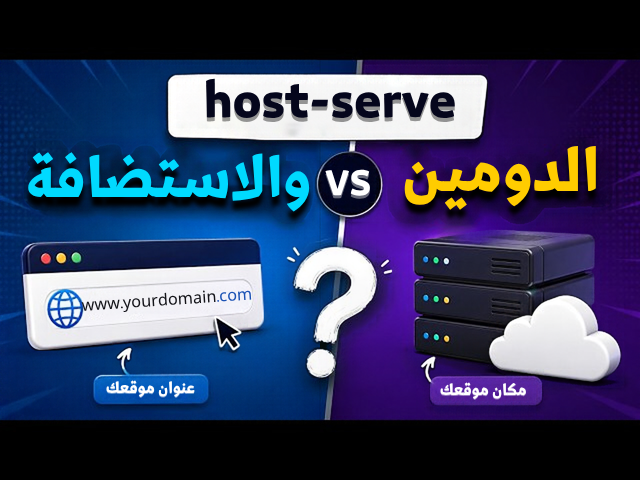
Everyone who starts a website hears the two words together: "register a domain and buy hosting." Some people think they are one thing, and others buy just one and wonder why their site doesn't show up. In truth they are two different services that work together, each with its own validity period, renewal and place of management.
In this guide we explain the difference between a domain and hosting with a simple example and a comparison table, then answer the practical question that matters to you: what happens to your site if one of them expires or you change it? We also show what Host Serve offers according to its official website.
Table of Contents
- The short answer
- The difference explained with a simple example
- How does a domain connect to hosting?
- 6 scenarios: what happens to your site?
- Who owns what, and where do you manage it?
- Do I always need both?
- Domain and hosting with Host Serve
- Common mistakes
- Frequently asked questions
- Conclusion
The Short Answer
A domain is your website's name that visitors type (like example.com). Hosting is the place where your site's files and database are stored on a server connected to the internet. The domain shows visitors the way, and the hosting holds the site itself. Your site appears to people only when both exist and are connected.
Comparison pointDomainHostingWhat is it?Your site's name and addressSpace on a server that stores your site's filesExampleexample.comA server storing your pages, images and databaseWhat does it do?Tells the browser where to lookHolds the site and sends it to the visitorWho provides it?A domain registrarA hosting companyValidity periodUsually yearlyDepends on the billing cycle (monthly, yearly...)What if it expires?Your site's address is no longer knownThe site itself stopsCan it be moved?Yes, between registrarsYes, between hosting companiesDoes it work alone?No, it needs hostingNo, it needs a domain to be easy to reach
The Difference Explained with a Simple Example
Think of the contacts list on your phone:
- The domain is the person's name in your contacts: "Ahmed."
- The IP address is his phone number, which is what the device actually dials.
- The hosting is the person himself who answers when you call, with everything he holds and knows.
- DNS is the contacts book that links the name to the number.
You type "Ahmed" because you don't remember the number, and the phone translates the name into a number and calls. A browser does the same: the visitor types the domain, DNS translates it to the IP address of the server hosting your site, and the visitor reaches the page.
If you saved a name in the book with no correct number, nobody answers. And if you have someone who answers but nobody knows his name, nobody will find him easily. That is why you need both.
For the technical detail of what happens behind the scenes, read how does web hosting work? (Arabic).
How Does a Domain Connect to Hosting?
The connection is made in one of two ways:
- Setting nameservers: you go to the domain's control panel and enter the nameservers your hosting company gives you. From then on, the hosting manages the DNS records.
- Setting DNS records manually: you keep the nameservers with the domain company and add an A record pointing to the hosting server's IP address.
When the domain and hosting are with the same company, the connection is usually made automatically.
After any DNS change, it may take from minutes to hours for the site to appear, and sometimes 24 hours or more, because DNS answers are cached.
6 Scenarios: What Happens to Your Site?
1. You bought a domain but no hosting
The domain is registered in your name, but no server carries your site, so opening it usually shows a blank page or a default page from the domain company, or an error. You cannot publish a site until you buy hosting and connect it.
2. You bought hosting but no domain
You can upload the site to the server, but it has no easy name. Some companies offer a temporary link or an IP address for previewing, but that isn't an address you can give customers. Ask your company about it, then register a domain and connect it.
3. The domain expired but the hosting remains
Your site's files are safe on the server, but people can't reach it by name. The email tied to the domain also stops. Many companies give a short grace period for renewal, but its length and the cost of recovering the domain vary, so don't rely on it. After that period the domain may be put up for sale, and someone else can buy it and benefit from your visitors and reputation.
4. The hosting expired but the domain remains
The domain is still yours, but the site stops working because no server answers. Your files and database may be deleted after a period set by the company's policy. So keep a backup outside the hosting, and check the company's policy.
5. You want to change hosting companies
Don't change the domain. You move the site to the new hosting, then change the nameservers or the A record in the domain panel to point to the new server. Free website migration is available on Host Serve plans. For the steps, read how to move your site without downtime (Arabic).
6. You want to change the domain name itself
Your hosting stays as it is, but the old address will stop. To protect your ranking and visitors:
- Connect the new domain to the hosting.
- Set up a permanent 301 redirect from the old one to the new one.
- Update internal links and sitemaps.
- Tell Google Search Console about the address change.
- Keep the old domain renewed for long enough.
Who Owns What, and Where Do You Manage It?
What you want to manageUsually whereDomain renewal and ownership detailsThe domain registrar's panelNameservers and DNS recordsThe domain panel (or the hosting, if you changed nameservers)Site files and databaseThe hosting panel (such as cPanel)SSL certificateUsually the hostingSite backupsThe hosting, and what you keep yourselfHosting renewalThe hosting company's panel
And there is a golden rule: always register the domain in your own name and with your own email, not in the name of the site developer or the design agency. Whoever owns the registrant account effectively controls the domain. Make sure you can transfer the domain or edit its settings whenever you want, and enable auto-renewal or set a reminder for the expiry date.
Do I Always Need Both?
- For your own site on the internet: yes, you need a domain and hosting.
- For a page on a ready-made platform (such as a store on an e-commerce platform): hosting may be included in the subscription, and you need a domain if you want your own name.
- For professional email (
name@yourcompany.com): you need a domain, and the email may be provided by the hosting or by a separate email service. - For a site with the hosting and domain from two different companies: possible, by connecting nameservers or DNS.
Domain and Hosting with Host Serve
According to the official website:
- The site offers a domain search box on its homepage to check whether a name is available.
- A free domain with the shared hosting plans (Starter, Business and Supreme) when you subscribe to the annual plan.
- Free website migration from your previous hosting.
- Free SSL on hosting plans.
What we did not find published on the plan pages: which extensions the free domain covers, its renewal price after the first year, and whether domains can be sold on their own. Ask support before subscribing. For more, read domain registration and web hosting in Egypt (Arabic).
The prices below are taken from the official website at the time of writing, in US dollars. Check the plans page for the latest offers.
PlanWebsitesSpaceMonthly Price (first-year offer)Annual RenewalStarter15 GB NVMe$2.50$59.88Business (most popular)320 GB NVMe$3.25$79.97SupremeUnlimited50 GB NVMe$5.19$139.00
Transparency note: Renewal prices are higher than the first-year offer. Calculate your cost over at least two years.
Common Mistakes
- Thinking a domain and hosting are the same thing.
- Registering the domain in the developer's or design company's name instead of yours.
- Forgetting to renew the domain, so the name is lost.
- Renewing hosting with no outside backup, then losing the files.
- Changing the domain without a 301 redirect, losing your ranking and visitors.
- Changing nameservers before the site is ready on the new hosting, so a blank site or an error appears.
- Keeping the domain and hosting login details with one person with no copy for yourself.
Frequently Asked Questions
What is the difference between a domain and hosting in short?
The domain is your site's name (its address), and hosting is the place where its files are stored. You need both for your site to work and for people to see it.
Can I buy the domain from one company and the hosting from another?
Yes, and it is common. You connect them by setting nameservers or DNS records. But buying from one company is easier to manage and connect.
What happens to my site if the domain expires?
People can no longer reach it by name and the email tied to it stops, even though your files are safe on the hosting. And ownership of the name may be lost if you don't renew within the grace period.
What happens if the hosting expires?
The site stops although the domain remains, and files may be deleted after a period set by the company's policy. Always keep a backup.
Can I change hosting without changing the domain?
Yes. You move the site, then change the nameservers or A record to point to the new server, and the domain stays as it is.
Is the domain free with Host Serve?
As advertised, it is free with the annual plan on shared hosting plans. Ask support about the covered extensions and the renewal price.
Do I need a domain if I only own hosting?
To give your site an identity and an easy address, yes. Without a domain it is hard for visitors to reach it, and you may not be able to enable SSL on your name.
Does connecting a domain to hosting take time?
The site may appear within minutes, or it may take hours, and sometimes 24 hours or more because of DNS propagation.
Conclusion
The difference between a domain and hosting is that the first is your site's name and address, and the second is where it is stored and served. Each depends on the other, and each has its own renewal and management. So register the domain in your own name, renew it on time, back up your site, and know where you manage everything.
Host Serve offers hosting plans with NVMe and LiteSpeed, plus free SSL, free migration and round-the-clock Arabic support, and a free domain when you subscribe to the annual plan.
Ready to start? Search for your site's name from the homepage, explore the hosting plans, create your account, or contact the team with any question about the domain.
Related articles (Arabic):
- Domain registration and web hosting in Egypt
- What is web hosting? A comprehensive beginner's guide
- How does web hosting work?
- Best hosting with a free domain and free SSL
- Steps to move your website to new hosting without downtime
- Best domain and web hosting company in Egypt
- Shared Web Hosting
Related Posts

💬 Comments
No comments yet — be the first to comment!